Pull Temperatures for Every Meat: The Carryover Chart for Grill and Smoker
This article may contain affiliate links. If you make a purchase through these links, we may earn a small commission at no extra cost to you. This helps us keep creating free content.

USDA FSIS puts the safe minimum for whole cuts of beef, pork, lamb and veal at 145 °F (63 °C) with a 3-minute rest, for all poultry at 165 °F (74 °C) and for ground meat at 160 °F (71 °C). Those three numbers decide whether food is safe. When you take the meat off the heat decides whether it is good, because the center keeps climbing for minutes after the lid closes on an empty grate. This chart gives you all three numbers for each meat: the safe minimum, the temperature you want to serve at, and the pull temperature that gets you there once carryover is done.
Safe minimum, serving target and pull point
Every line in the tables below carries three temperatures, and mixing them up is the most common reason for an overcooked roast or an undercooked bird.
- Safe minimum: the USDA FSIS number. Below it, the meat has not reached the temperature the agency recommends for killing pathogens.
- Serving target: the temperature the center should read when you slice. For a tri-tip at medium-rare that might be 135 °F (57 °C); for a pork butt it is closer to 203 °F (95 °C), because the goal there is collagen breakdown.
- Pull temperature: the reading at which the meat leaves the heat. It sits below the serving target by the expected carryover.

For poultry and ground meat, the safe minimum and the serving target are the same number, and the pull point may only drop below it if you check again after the rest. More on that in the chicken and turkey sections.
The USDA numbers in one table
| Food | USDA safe minimum | Rest required |
|---|---|---|
| Beef, pork, veal, lamb: steaks, chops, roasts | 145 °F (63 °C) | 3 minutes |
| Ground beef, pork, veal, lamb | 160 °F (71 °C) | none |
| All poultry, whole, parts and ground | 165 °F (74 °C) | none |
| Fresh or raw ham | 145 °F (63 °C) | 3 minutes |
| Fully cooked ham from a USDA-inspected plant, reheated | 140 °F (60 °C) | none |
| Fin fish | 145 °F (63 °C) or flesh opaque and flakes with a fork | none |
| Leftovers and casseroles | 165 °F (74 °C) | none |
The 3-minute rest for whole cuts is part of the safety rule, not a flavor tip. During those minutes the temperature holds or keeps climbing, which adds lethality on top of the 145 °F reading.
TempPro TempSync wireless meat thermometer
TempPro TempSync wireless meat thermometer, 500 ft
Ad · Affiliate link to Amazon.
How many degrees meat rises after you pull it
Carryover happens because the outside of the meat is hotter than the center when you take it off. Heat keeps flowing inward until the gradient evens out. Two things set the size of the rise: how thick the piece is, and how big the gap was between cooker temperature and internal temperature.
| Cut and cook | Typical carryover |
|---|---|
| Thin steak, chop or chicken breast, under 1 inch (2.5 cm), direct heat | 2 to 5 °F (1 to 3 °C) |
| Thick steak or tenderloin, 1.5 to 2.5 inches (4 to 6 cm), 400 °F (204 °C) and up | 5 to 8 °F (3 to 4 °C) |
| Large roast, 4 lb (1.8 kg) and up, 325 to 375 °F (163 to 191 °C) | 5 to 10 °F (3 to 6 °C) |
| Same large roast, smoked at 225 to 250 °F (107 to 121 °C) | 2 to 5 °F (1 to 3 °C) |
| Brisket or pork butt after a long smoke | small, often 0 to 5 °F, and it falls fast once unwrapped |
These ranges are rules of thumb collected from cooking references, not lab values, and your grill, wind and wrap all shift them. Log your own readings for a few cooks and you will know your number within a degree or two. Low-and-slow cooking keeps carryover small because the surface never gets much hotter than the center; that is one reason reverse-searing works so well.
Steaks and tri-tip: pull points by doneness
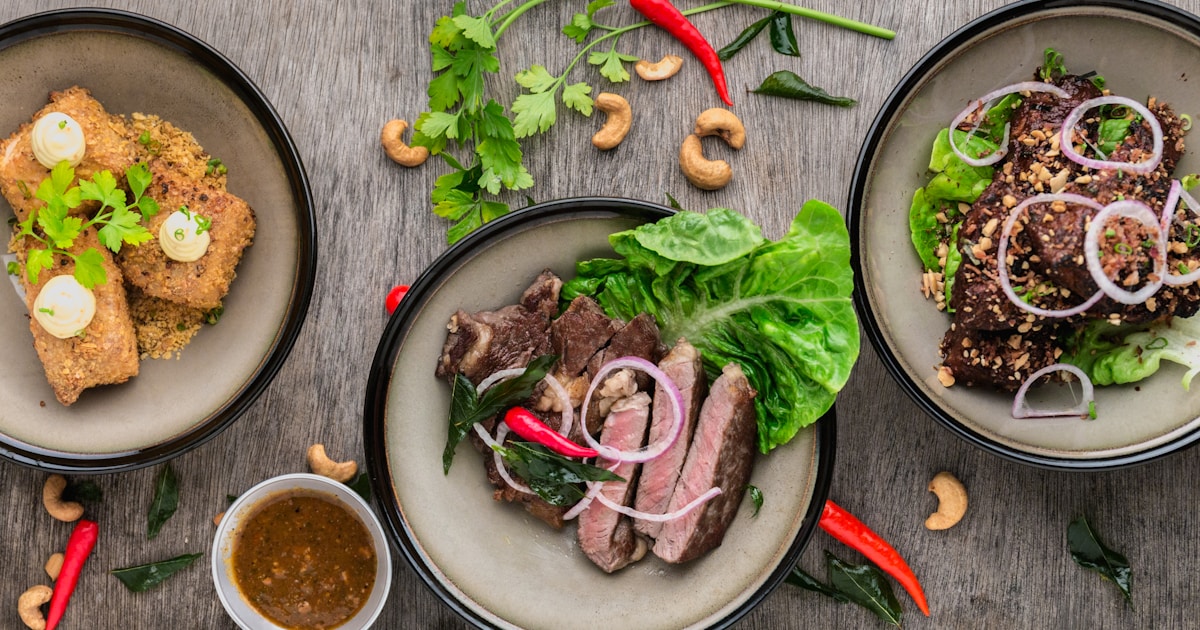
Here is where safety and preference split. USDA FSIS recommends 145 °F for whole beef cuts, which lands at medium. Many cooks serve steak rarer than that; if you do, you are choosing a texture below the federal recommendation, and the people at your table should know it. The table shows both, so the choice stays yours.
| Doneness | Serving temp | Pull, thick steak (5 to 8 °F carryover) |
|---|---|---|
| Rare | 125 °F (52 °C) | 118 to 120 °F (48 to 49 °C) |
| Medium-rare | 135 °F (57 °C) | 128 to 130 °F (53 to 54 °C) |
| Medium (USDA minimum) | 145 °F (63 °C) | 138 to 140 °F (59 to 60 °C) |
| Medium-well | 150 to 155 °F (66 to 68 °C) | 145 to 148 °F (63 to 64 °C) |
| Well done | 160 °F (71 °C) and up | 155 °F (68 °C) |
For a thin skirt or flank steak, shrink the gap to 2 to 3 °F, because there is not enough mass to push the center much further. If you aim for the USDA 145 °F, read the steak again after the rest and confirm it got there. The method behind thick steaks is in our reverse sear guide.
Prime rib, strip loin and other big beef roasts
A bone-in standing rib roast of 3 to 4 ribs weighs roughly 7 to 10 lb (3.2 to 4.5 kg), and this is where carryover gets big enough to wreck the plan. Roasted at 325 °F (163 °C) or finished with a hot sear, a roast that size can climb 8 to 10 °F during a 20 to 30 minute rest. For a medium-rare center of 130 to 135 °F, that means pulling at about 120 to 125 °F (49 to 52 °C).
Smoke the same roast at 225 °F (107 °C) and the rise shrinks to a few degrees, so you pull closer to the serving number. The step-by-step cook for the holidays lives in our smoked prime rib guide; this chart only covers when to take it off. If anyone at the table needs the USDA number, cut their slices from the ends, which run several degrees hotter than the center.

Brisket, chuck roast and pork butt: tender beats done
For tough, collagen-rich cuts, the safe minimum is passed hours before the meat is edible. Brisket and pork butt pass 145 °F hours before they are ready to slice or pull. What you are waiting for is collagen turning into gelatin, which happens over time in the range of roughly 160 to 205 °F (71 to 96 °C).
- Brisket: start probing at 195 °F (91 °C); most finish between 200 and 205 °F (93 and 96 °C).
- Pork butt for pulling: 200 to 205 °F (93 to 96 °C), when the bone wiggles freely.
- Chuck roast for pulling: 200 to 205 °F, same probe feel as brisket.
- Beef plate or chuck ribs: about 200 to 205 °F.
The deciding signal is the probe sliding in with almost no resistance, and the thermometer only tells you when to start checking. Carryover barely matters here. What matters is the hold: a wrapped brisket in a dry cooler stays above 140 °F (60 °C) for several hours, so you can pull it on time and serve later. The full cook is in brisket from trim to table.
Pork chops, tenderloin and loin roast
Pork got its 145 °F rating in 2011, when USDA lowered the whole-cut recommendation from 160 °F and added the 3-minute rest. At 145 °F the center of a chop is faintly pink and juicy, which is the point.
| Cut | Serving | Pull |
|---|---|---|
| Thin chop, under 1 inch, direct heat | 145 °F (63 °C) | 142 °F (61 °C) |
| Thick chop, 1.5 inches and up | 145 to 150 °F | 138 to 140 °F (59 to 60 °C) |
| Tenderloin, about 1 lb (450 g) | 145 °F | 140 °F (60 °C) |
| Bone-in loin roast, 4 to 6 lb | 145 to 150 °F | 135 to 138 °F (57 to 59 °C) |
Whatever you pull at, the 145 °F has to show up on the thermometer after the rest. If a thin chop comes off at 142 °F and only reads 144 °F three minutes later, give it another minute on the warm side.
Chicken: breasts, thighs and whole birds
USDA FSIS sets one number for all poultry: 165 °F (74 °C), measured in the thickest part. That is a hard line, and pulling early only works if you confirm it after the rest.
- Boneless breast: on direct heat, pull at about 161 to 162 °F (72 °C). A breast this thin rises 2 to 4 °F. Read it again after 3 to 5 minutes; it must show 165 °F.
- Thighs and drumsticks: safe at 165 °F, but the connective tissue renders better at 175 to 185 °F (79 to 85 °C). Dark meat stays juicy that high, so there is no reason to pull early.
- Whole chicken, about 4 to 5 lb: check the thickest part of the breast and the inner thigh. Pull when the breast reads about 160 °F and the thigh at least 170 °F, then verify 165 °F in the breast after a 10-minute rest.
A spatchcocked bird cooks more evenly, which closes the gap between breast and thigh. See our spatchcock walkthrough for the cut.
Whole turkey, breast and tenderloin
For a whole turkey, FSIS says to check three spots: the thickest part of the breast, the innermost part of the thigh and the innermost part of the wing. All three need 165 °F (74 °C). A 12 to 14 lb (5.4 to 6.4 kg) bird roasted or smoked at 325 °F (163 °C) can rise 5 to 10 °F in the breast during a 30-minute rest, so many cooks pull at 157 to 160 °F (69 to 71 °C) in the breast. That only counts as done once the post-rest reading hits 165 °F.
A boneless turkey breast of 3 to 4 lb rises somewhat less, around 4 to 7 °F, and the tenderloin, as noted above, about 3 to 5 °F. Smoked at 250 °F (121 °C), all of these rises shrink. If you want to weigh oven against smoker for the holiday bird, read the Thanksgiving comparison.
Burgers and sausages get no carryover discount
Ground meat is the exception to everything above. Grinding spreads surface bacteria through the whole patty, so the center needs 160 °F (71 °C), or 165 °F (74 °C) for ground turkey and chicken. A 3/4-inch (2 cm) patty off direct heat rises only 1 to 3 °F, so pull at the target, not below it.
Fresh sausages follow the same rule: 160 °F for pork or beef, 165 °F for poultry sausages. Pre-cooked sausages like most hot dogs are already cooked; FSIS advises anyone at higher risk of listeriosis, such as pregnant women, older adults and people with weakened immune systems, to reheat them to 165 °F (74 °C) or until steaming hot. Checking a sausage means pushing the probe in from the end, lengthwise, so the tip sits in the middle.
Lamb and fish
Lamb chops and leg of lamb follow beef: 145 °F (63 °C) with a 3-minute rest as the USDA minimum. A bone-in leg of 5 to 7 lb rises 5 to 8 °F off a 350 °F (177 °C) grill, so pull at about 137 to 140 °F (58 to 60 °C) for the 145 °F finish. Ground lamb for kofta or burgers goes to 160 °F.
Fish has little mass and little carryover. A salmon fillet 1 inch thick rises 2 to 3 °F. USDA lists 145 °F for fin fish, or flesh that is opaque and separates easily with a fork. If you smoke salmon, the hot-smoked style follows these numbers; cold smoking is a separate process covered in our salmon guide.
Probe placement decides whether any of this works
A pull temperature is only as good as the spot you measure. Five rules cover nearly every cook:
- Aim for the geometric center of the thickest part, not the middle of the length.
- Stay off the bone. Bone conducts heat differently and gives a false reading, usually high.
- Keep the tip out of fat pockets and out of the cavity on poultry.
- Insert from the side on thin cuts, so the full sensing tip sits in meat.
- Take a second reading 1 inch away. If the two disagree by more than 5 °F, trust the lower one.
A leave-in probe such as the TempPro TempSync (on Amazon, affiliate link) tells you when to get close; an instant-read like the TempPro TempSwift (on Amazon, affiliate link) confirms the final number in several spots. Check either one in ice water now and then: it should read 32 °F (0 °C). Our instant-read roundup explains what separates a fast thermometer from a slow one.
Resting and holding without the danger zone
FSIS calls 40 to 140 °F (4 to 60 °C) the danger zone, where bacteria multiply fastest. Cooked meat should not sit in that range for more than 2 hours in total, or 1 hour when the air is above 90 °F (32 °C). For a rest that is never a problem, since a steak or roast stays well above 140 °F for its 5 to 30 minutes. It becomes one when you hold a cook for a late crowd.
- Wrapped brisket or pork butt in a dry, pre-warmed cooler: check it is still above 140 °F (60 °C) before serving.
- Oven hold: set to 150 to 170 °F (66 to 77 °C) if your oven goes that low.
- Leftovers: refrigerate within 2 hours and reheat to 165 °F (74 °C).
How long each cut should rest, and what happens to the juices meanwhile, is covered in how to rest meat properly. This chart only fixes the number at which the rest begins.
Turning the chart into a pull plan
Before the next cook, write three numbers on a piece of tape on the lid: safe minimum, serving target, pull point. For a 2-inch ribeye heading to medium that reads 145, 145, 139. For a 13 lb turkey it reads 165, 165, 159 with a post-rest check. For a pork butt it reads 145, 203, and "probe tender". After the rest, note the real final temperature next to the pull point. After three or four cooks the gap between those two numbers is your own carryover, measured on your grill, and you can stop guessing.
Sources: USDA FSIS, "Safe Minimum Internal Temperature Chart" and "Danger Zone (40 °F to 140 °F)" (fsis.usda.gov); USDA FSIS, "Let's Talk Turkey: A Consumer Guide to Safely Roasting a Turkey"; USDA news release of May 24, 2011 on the revised 145 °F recommendation for whole cuts of pork. Carryover ranges are general cooking guidance, cross-checked against AmazingRibs.com as a secondary reference.
🔥Disclaimer: This article is for informational purposes only. Grilling with charcoal, gas, or briquettes carries risks — from flare-ups and burns to carbon monoxide poisoning. Never grill in enclosed spaces, keep the grill at least 5 feet from flammable materials, and verify meat internal temperatures with a thermometer (poultry min. 165°F / 75°C, ground meat min. 160°F / 70°C, beef steaks safe rare at 130°F+ if surface-seared).
Published by the Backyard BBQ Grill editorial team. Published November 26, 2026.
Editorial responsibility: see Imprint.
Spotted an error or have something to add? corrections@backyardbbqgrill.com
You might also like

Explore more
All articles on Backyard BBQ Grill →
Grill Smarter, Not Harder
Weekly tips on grilling, smoking, and gear picks — delivered every Saturday.
🎁 Free bonus: BBQ Starter Kit (PDF)